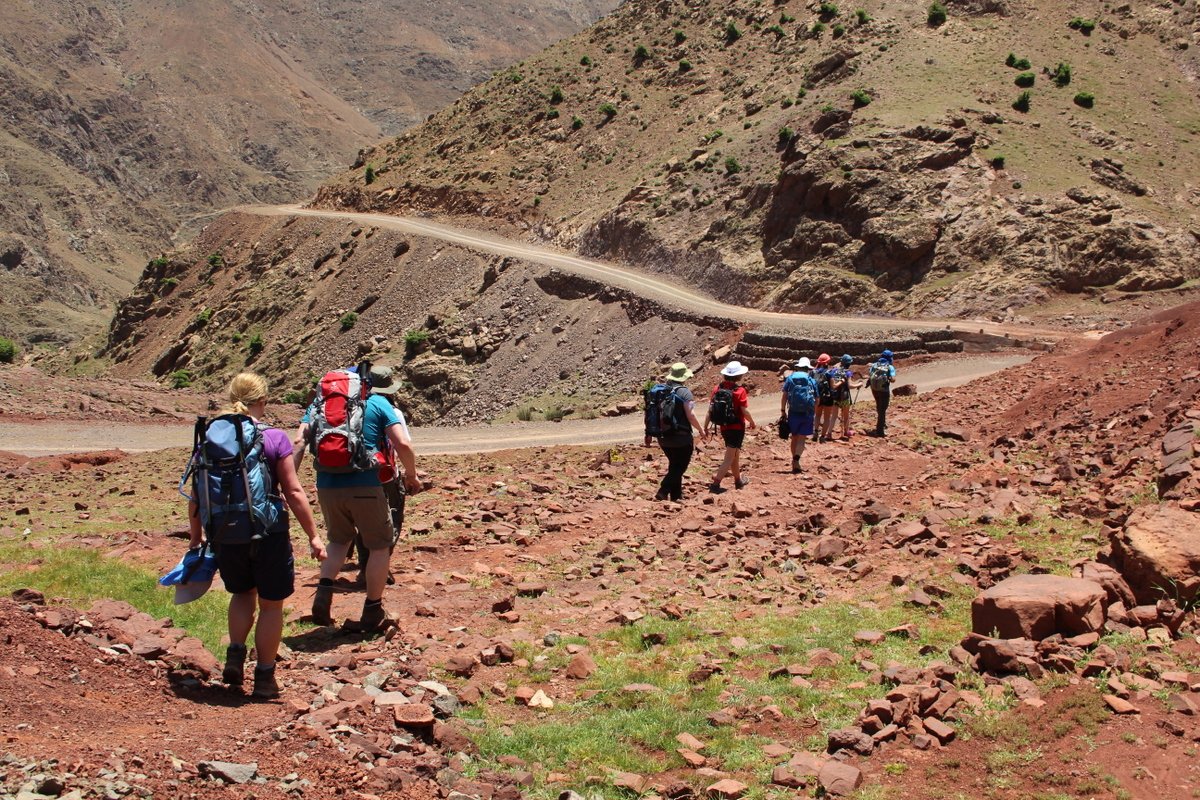
Toubkal · Mgoun · Berber Valleys · Winter Ascents

Atlas Mountains Trekking Africa's Summit Awaits.

4,167m
Jbel Toubkal
Highest Peak
4,071m
Jbel M'Goun
Traverse Route
2 Days
Toubkal Summit
Minimum

From the walnut-shaded trails of Ourika Valley to the scree slopes of North Africa's highest peak — the Atlas Mountains offer trekking for every pace and ambition. All led by licensed Berber mountain guides who have walked these routes their entire lives.

★★★★★ 4.9428+ verified reviews
State-Licensed GuidesFRMAM certified, English-speaking
100% Private GroupsYour group only, always
Year-Round TreksSummer summits & winter ascents
Free Itinerary in 24hNo commitment required
Toubkal Summit — 4,167m · North Africa's Highest
M'Goun Traverse — 6 Days · True Wilderness
Licensed Berber Mountain Guides
From Beginner Walks to Summit Ascents
Private Berber Gîtes · No Shared Dormitories
Winter Crampons Ascent · Dec–Feb
4.9★ · 428 Trekking Reviews
90 Minutes from Marrakech to Imlil
The Atlas Range

From Berber Valleys
to Africa's Summit

The High Atlas is one of the world's great walking ranges — accessible enough for a motivated first-timer, wild enough to challenge the most experienced trekker. At its centre stands Jbel Toubkal, 4,167 metres above sea level, the highest point in North Africa. Most people who summit it had never climbed anything like it before.

The range stretches for 2,400km across Morocco, Algeria and Tunisia. Our treks focus on the High Atlas — the section near Marrakech — and the wilder Central Atlas, home of the M'Goun Traverse, a 6-day wilderness route through valleys that see almost no other trekkers.

Every trek departs from Marrakech. Imlil, the mountain gateway village, is just 90 minutes away — a reminder that this extraordinary landscape is genuinely accessible from the city.

Trek / Route Grade Days Max Altitude Fitness
Easy Atlas Walk
1 day 1,800m Gentle walker
Toubkal — 2 Days
2 days 4,167m Regular hiker
Toubkal — 3 Days
3 days 4,167m Regular hiker
M'Goun Traverse
6 days 4,071m Experienced hiker
Winter Toubkal
3 days 4,167m Fit hiker + cold exp.
Toubkal summit panorama — Atlas Mountains Morocco

Toubkal summit at 4,167m — first light over the Atlas
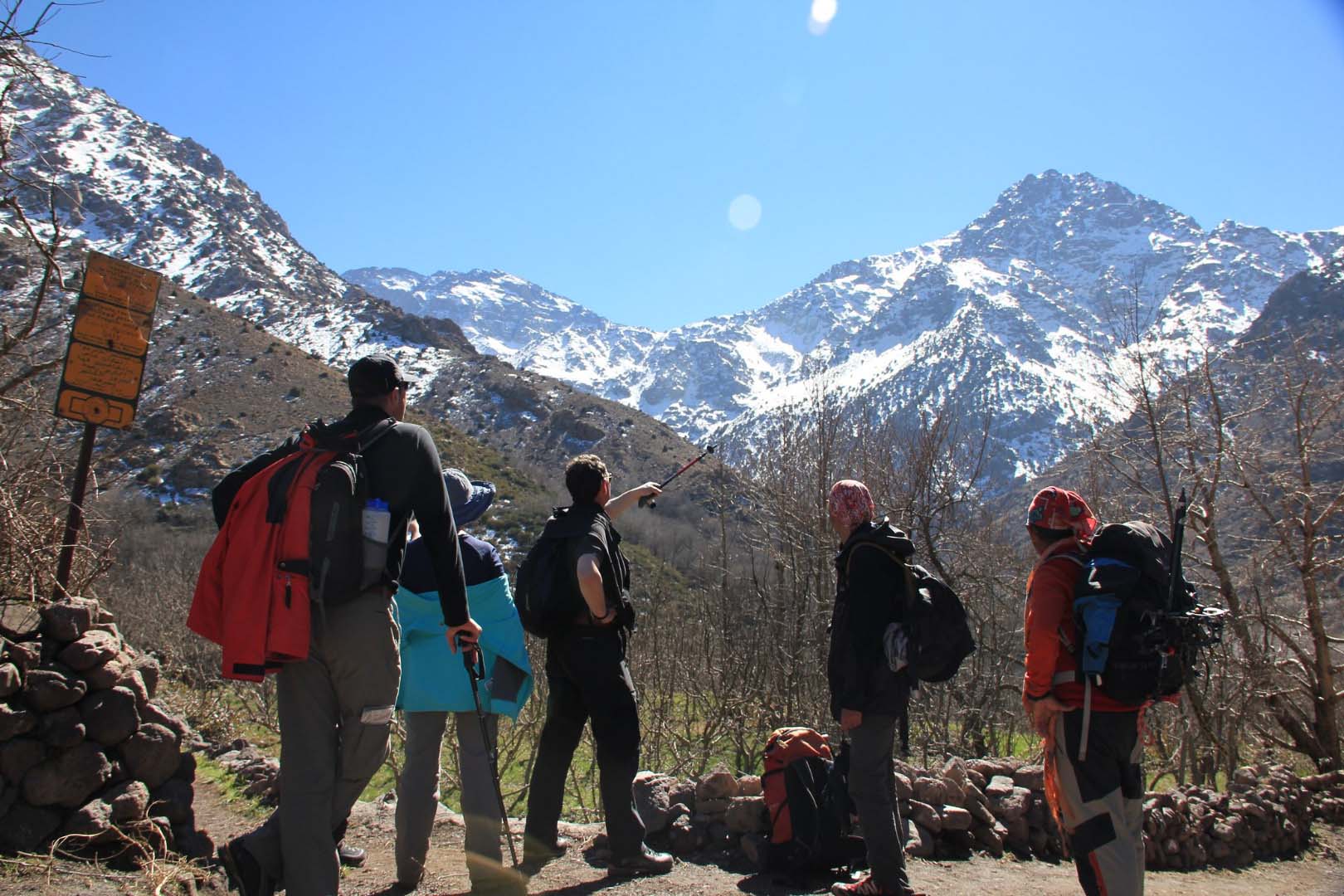
Imlil village Atlas Mountains Morocco trekking
Atlas Mountains Berber trail trekking Morocco
Choose Your Trek

Atlas Mountains Trek Packages

Every trek is 100% private — your group, your pace, your mountain guide.

Recommended
4,167m
3 Days / 2 Nights
Imlil · Aroumd · Toubkal
Toubkal Trek — 3 Days
Grade 3 · Regular hiker

The recommended Toubkal itinerary. Day 1 acclimatisation walk through Berber villages above Imlil, night in a private gîte. Day 2 to Toubkal Refuge. Day 3 summit and return. More relaxed, better acclimatised, higher summit success rate.

Wilderness Trek
4,071m
6 Days / 5 Nights
Central High Atlas
M'Goun Traverse
Grade 4 · Experienced hiker

Morocco's finest multi-day wilderness trek. Six days through the Central High Atlas — crossing M'Goun (4,071m), walking ancient Berber mule routes through the Aït Bou Guemez valley, sleeping in remote gîtes that see almost no other trekkers. Entirely untouched by mass tourism.

Dec · Jan · Feb
4,167m
3 Days / 2 Nights
Winter Ascent · Crampons
Winter Toubkal Ascent
Grade 4 · Fit hiker + cold experience

Toubkal under snow is a completely different mountain. Crampons and ice axe required from December to March. The Atlas turns a deep, silent white. The refuge is half-empty. The summit views stretch over a snow-covered range that feels genuinely alpine. One of Morocco's most extraordinary experiences.

Beginner Friendly
1,800m
1 Day (6–7 hrs)
Imlil · Berber Villages
Easy Atlas Walk & Berber Villages
Grade 1 · Gentle walker

The Atlas without the altitude — a full day walking through walnut groves, terraced fields and Berber hamlets above Imlil. Lunch with a local family. The mountain experience, without the summit. Perfect for families, older travellers, or anyone who wants to feel the Atlas at a gentler pace.

Your Mountain Guides
Licensed Berber mountain guide Atlas Morocco
12+

Average years of guiding experience per guide
Born in the Imlil region

Licensed Berber Mountain Guides

Born on These Mountains

Every guide was born and raised in the Imlil valley or surrounding Berber villages. They know every ridge, every shortcut, every family who will invite you in for tea. The Atlas is not their workplace — it is their home.

State-Licensed & Certified

All guides hold a licence from FRMAM (the Royal Moroccan Federation of Mountain Sports). Moroccan law requires a licensed guide in Toubkal National Park — we comply, and we only work with guides who have passed the full certification programme.

English-Speaking & Culturally Rich

Our guides speak Tachelhit (Berber), Darija (Moroccan Arabic), French, and English. They explain the geology of every ridge, the history of every village, and the meaning of every Berber tradition you encounter on the trail.

Safety-Trained & First-Aid Certified

Every guide carries a full mountain first-aid kit and holds a wilderness first-aid certificate. They have direct contact with mountain rescue services and know the evacuation routes from every point on every route we operate.

All guides licensed by FRMAM — Royal Moroccan Federation of Mountain Sports
Minimum 5 seasons of certified guiding required

Where You'll Sleep

Trekking Accommodation

Three types of mountain accommodation — each part of the experience, not just a place to sleep.

Nights 1 & 3 (3-day treks)

Berber Gîte — Imlil

A traditional Berber stone farmhouse in Imlil village — the starting point for all Toubkal treks. Private rooms for your group, traditional Moroccan dinner and breakfast, and a rooftop terrace with Atlas views at sunset.

Private rooms — no dormitory sharing
Hot shower after the trek
Traditional Berber dinner included
Mountain views from every window
Night 2 (at the base of the summit)

Toubkal Refuge — 3,207m

The CAF mountain hut below Toubkal's south cirque — a landmark of Atlas trekking. Bunkbed dormitories, hot meals, and the extraordinary experience of sleeping at 3,207m above sea level with the summit directly above you.

3,207m altitude — acclimatisation built in
Hot dinner and breakfast at the hut
Early 5am summit departure from the hut
Dormitory — shared with other groups
M'Goun Traverse · Nights 1–5

Remote Valley Gîtes

On the M'Goun Traverse, you sleep in small Berber gîtes in remote valley villages that see almost no tourists. Stone rooms, blankets, lantern light, and the sound of mules outside. The most authentic mountain accommodation in Morocco.

Private occupation — your group only
Traditional Berber meals throughout
Minimal electricity — true remoteness
Community-owned — benefits local families
Important Information

Do You Need a Guide for Toubkal?

Yes — and this is not a suggestion. Moroccan law requires all trekkers in Toubkal National Park to be accompanied by a licensed Mountain Guide (certified by FRMAM). Independent trekking in the high Atlas is not permitted and carries real safety risks.

This is not bureaucracy — it is the reason the Atlas has an excellent safety record. Our guides have been walking these mountains their entire lives. They read the weather, know the evacuation routes, and have prevented dozens of emergencies over their careers.

Book a Licensed Guide →
What Your Guide Provides
Route Navigation

The Atlas trails are unmarked. Your guide navigates with decades of route knowledge — no GPS dependency, no guesswork.

Weather Assessment

Summit conditions change in minutes at altitude. Your guide makes the call on whether to push on or descend — their judgment has kept every client safe.

Cultural Translation

Every village you pass through has a story. Your guide speaks Tachelhit — the Berber language — and translates a world most visitors never access.

Emergency Response

Wilderness first-aid certified, mountain rescue contacts, and full evacuation kit. In 12+ years of guiding, our team has never lost a client.

Plan Your Timing

Best Time to Trek the Atlas

The Atlas is a year-round destination — but each season offers a completely different experience. Here is the honest guide.

Month Conditions Temperature (Summit) Rating Best For
January Heavy snow, crampons essential −10°C to −5°C Winter Ascent Snow experience, winter trekkers
February Deep snow, cold clear days −8°C to −3°C Winter Ascent Crampons season, quiet trails
March Snow melting, muddy trails −2°C to +5°C Good Shoulder season, fewer crowds
April Wildflowers, spring streams +2°C to +8°C Excellent Scenic beauty, comfortable hiking
May Clear skies, ideal temperatures +5°C to +12°C Best Season Summit attempts, all treks
June Hot valleys, cool summit +8°C to +15°C Excellent Early start recommended, summit ideal
July Very hot below 2,000m +10°C to +18°C Good High-altitude only, depart at dawn
August Hottest month, busy refuge +10°C to +18°C Challenging Avoid valley walks, summit possible
September Perfect clarity, warm days +5°C to +14°C Best Season All treks, M'Goun ideal
October Golden light, cool nights +2°C to +10°C Best Season Photography, all treks, fewer tourists
November First snow above 3,000m −2°C to +6°C Good Quiet trails, atmospheric conditions
December Full winter, crampons from mid-month −8°C to −2°C Winter Ascent Snow experience, Christmas trekkers
Summit Stories

Trekking Reviews

4.9
★★★★★

428 verified reviews
Google · TripAdvisor · Trustpilot

★★★★★
Toubkal 2-Day Summit

"I had never climbed anything above 2,000m in my life. Our guide Mohammed told me on the first day that I would reach the summit. He was right. Standing at 4,167m above Africa, I cried. The whole experience — the village, the refuge, the dawn climb — was the most meaningful thing I have ever done on holiday."

🇬🇧
Sarah W.Toubkal Summit · Bristol, UK
Google
★★★★★
M'Goun Traverse · 6 Days

"The M'Goun traverse was unlike anything I have done in 20 years of trekking. Six days through valleys with no other trekkers, sleeping in stone farmhouses, waking to mountains with no one else in sight. Our guide Brahim knew every family along the route. This is what trekking used to be."

🇩🇪
Klaus & Petra M.M'Goun Traverse · Hamburg
TripAdvisor
★★★★★
Winter Toubkal · January

"We did the winter ascent in January with crampons and ice axes. Absolutely spectacular — the Atlas completely white, the refuge half empty, the summit views over a frozen landscape. Our guide had summited in winter over 200 times. We felt completely safe and completely amazed. Nothing like it."

🇫🇷
Jean-Pierre L.Winter Ascent · Lyon, France
Trustpilot
Build Your Own
A different route in mind?
We'll design it.

Jebel Sahro in winter? Toubkal combined with the Sahara? A 10-day traverse across the full High Atlas? We'll build any trekking itinerary in Morocco around your dates, fitness, and ambitions.

Design My Trek → Free · Ready in 24h · No obligation
Quick Answers

Trekking Questions

Everything you need to plan your Atlas trek — from fitness requirements to packing lists and permit questions. Our team responds within 2 hours if you need more.

Still unsure which trek?

Tell us your fitness level, available days, and what you're looking for. We'll recommend the right trek — honestly, not just the most expensive one.

WhatsApp Us →
Toubkal is not technically difficult — there are no ropes, no rock climbing, no technical mountaineering skills required in summer. It is a demanding mountain hike: you need to be comfortable hiking 6–8 hours with a 1,500m elevation gain in a day. Grade 3 out of 5. A regular hiker who walks 10–15km with hills can summit with good preparation. The 2-day ascent has a very high success rate when clients are fit and well-paced by their guide. In winter (crampons season), the grade rises to 4/5 and prior experience of winter conditions is strongly recommended.
Yes — and this is Moroccan law, not just a recommendation. All trekkers in Toubkal National Park must be accompanied by a licensed Mountain Guide certified by FRMAM (the Royal Moroccan Federation of Mountain Sports). Independent trekking in the high Atlas is not permitted. Beyond the legal requirement, the trails are unmarked, conditions change rapidly at altitude, and the cultural experience you will have with a Berber guide who was born in Imlil is a fundamental part of what makes an Atlas trek extraordinary.
The minimum is 2 days: Day 1 hike from Imlil to the Toubkal Refuge (3,207m); Day 2 summit at dawn and return to Imlil. We recommend 3 days for better acclimatisation: Day 1 acclimatisation walk in the Imlil valley; Day 2 to the Refuge; Day 3 summit and descent. The 3-day version has a noticeably higher summit success rate. The full Toubkal circuit (walking a different route on the return) takes 4–5 days.
May–June and September–October are the best months: ideal temperatures, clear skies, low crowds. Spring brings wildflowers and snowmelt streams; autumn has golden light and the most stable weather. July–August is possible but hot in the valleys — start early and stay high. December–February is the winter crampons season — spectacular snow conditions but requires full winter kit and an experienced guide. March–April is variable — some snow, some mud, increasingly beautiful as the month progresses.
A simple self-assessment: can you walk 15km with sustained uphill for 4–5 hours? If yes, you can summit Toubkal with good preparation. You do not need to be a mountaineer or a runner. The key is cardiovascular fitness and a tolerance for sustained effort. We recommend training with loaded day hikes in the 3–4 months before. Our guides pace every client individually — we have summited with guests aged 12 to 74. If you are uncertain, choose the 3-day itinerary which adds an acclimatisation day.
No hiking permit is required for Toubkal — there is a nominal Toubkal National Park entrance fee (approximately 30 MAD / €3) paid on arrival. However, a licensed guide is legally mandatory. There is no permit system as you might find on Kilimanjaro or Everest base camp — the regulation is guide-based, not permit-based. We handle all logistics including the park entrance.
The M'Goun Traverse is a 6-day wilderness trek through the Central High Atlas — Morocco's finest multi-day mountain route. It crosses M'Goun (4,071m, Morocco's second-highest peak), traverses the remote Aït Bou Guemez valley, and passes through Berber villages that almost no tourists visit. It is for experienced hikers comfortable with 6–8 hours of walking per day on unmarked high-altitude terrain. The complete absence of other trekkers is its defining characteristic — you will have the mountains entirely to yourselves.
On a 2-day trek: one night at the Toubkal Refuge (CAF mountain hut at 3,207m — dormitory bunks, hot meals). On a 3-day trek: first night in a private Berber gîte in Imlil (private rooms for your group); second night at the Toubkal Refuge. On the M'Goun Traverse: all nights in remote Berber gîtes in valley villages — privately occupied for your group with traditional meals throughout. We do not use shared dormitories except at the Toubkal Refuge, where it is unavoidable.
Yes — and many of our guests are solo female trekkers, including women who joined us alone and found the experience deeply rewarding. The Berber mountain communities are welcoming, respectful, and safe. Our guides are vetted and licensed. The private group format means you are never trekking with strangers. We can also arrange a female guide on request for guests who prefer this. We have never had a safety incident involving a solo female guest in our trekking history.
Essentials: broken-in hiking boots (ankle support, waterproof); layered clothing (30°C at Imlil, 0°C at summit); waterproof jacket and trousers; thermal base layer for the refuge night; head torch (summit starts at 5am in the dark); sun protection (SPF 50+, sunglasses, hat); trekking poles (strongly recommended); 2-litre water capacity. For winter: add crampons, ice axe, down jacket, wool balaclava, double gloves. We send a full packing list to every booked guest and can advise on gear rental in Imlil if needed.
The Toubkal summit cannot be done as a day trip — the minimum is 2 days overnight. However, the Atlas foothills are excellent as a day trip: our Easy Atlas Walk & Berber Villages day trip covers Imlil, traditional Berber hamlets, walnut groves, and mountain trails up to 1,800m — back in Marrakech the same evening. For the summit experience, the minimum commitment is 2 days. See our Marrakech Day Trips page for the Atlas day trip option.
The Summit Awaits

Book Your Atlas Trek

Tell us your trek preference, fitness level, available dates, and group size — we'll send a personalised trekking plan with full pricing within 24 hours.

Or WhatsApp us · We respond within 2 hours · Always private · Always licensed guides

💬
Scroll to Top